Old age and technological devaluation
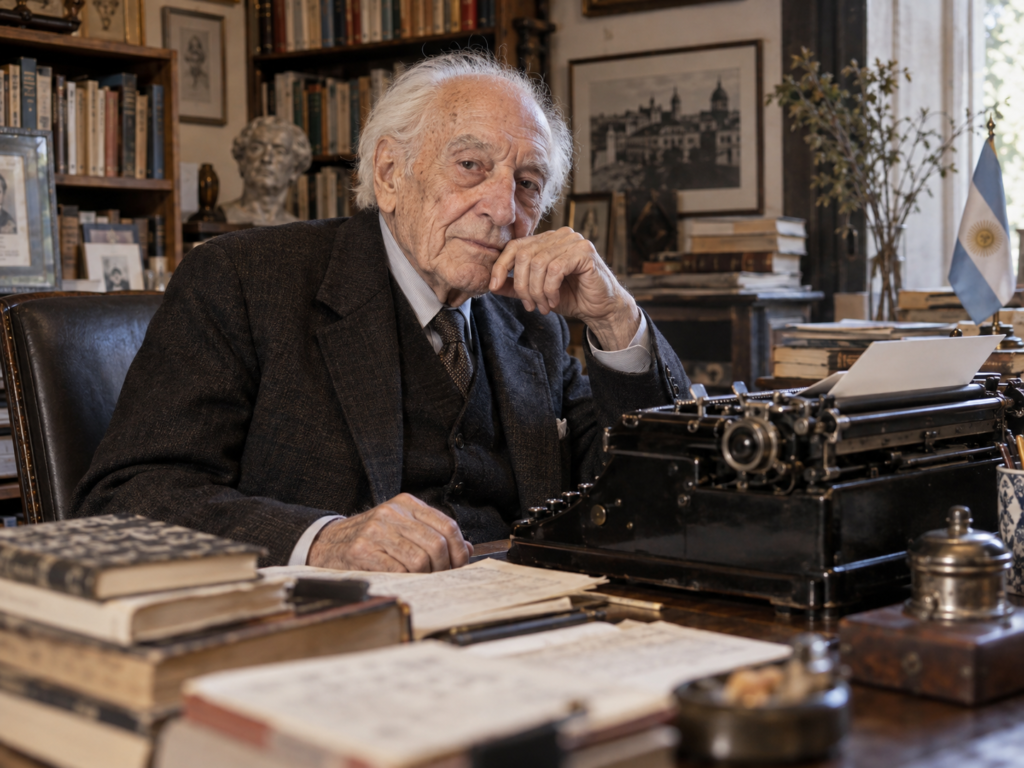
Juan Filloy, escritor cordobés centenario, frente a su máquina de escribir. Su longevidad sirve como punto de partida para analizar el lugar de los adultos mayores en sociedades atravesadas por rápidos cambios tecnológicos.
The photograph of Juan Filloy, the writer from Córdoba famous, among other things, for his “palindromes,” vigorous and expressive as he turns 100, is an image of the strength of the human spirit. The man, portrayed in front of his venerable typewriter, seems carved out of rock; a message of character, “in the manner of Sarmiento.”
Looking at him, one is tempted to refute those who insist that there is a growing “generation gap” in modern societies. This is, however, something that increasingly occupies the attention of sociologists and social psychologists.
One striking fact showing how much human life has changed since the Industrial Revolution is greater longevity. In modern societies, as a consequence of better nutrition, sanitation and healthcare, life expectancy is now almost twice what it was in 1900. In the United States, the average rose from 47 years at the beginning of the century to 75 in 1990; in Sweden, 18 percent of the population is already over 65 years old.
In the first of these countries, studies have been published on the less favorable side of the social problems brought about by increased longevity. And not only at the general socioeconomic level, but also between generations. Consider, for example, the issue of life-support technology. In 1986 there were 10,000 Americans living in irreversible vegetative or comatose states who were being sustained by technical means at enormous financial and psychological cost. Half of the many thousands receiving mechanical ventilation, kidney dialysis or intravenous feeding were over 65.
In that society, meanwhile, young people leave their parents’ homes at an increasingly early age. Once independent, with jobs and families of their own, they move farther away from home and maintaining ties becomes more difficult. If their parents begin to decline physically, it is common to place them in a nursing home, where responsibility is assumed by “professionals.” There, inactive, the elderly deepen their passivity by consigning themselves to television.
Sociological studies reveal a variety of problems related to a widening intergenerational gulf. Young people enter earlier into a productive system based predominantly on information. Their parents become unproductive in that mediated world. The bill for housing, care and sophisticated medical assistance rises considerably…
The general tone of society encourages the elderly to be perceived increasingly as obsolete, idle and even parasitic. The speed of technological change aggravates what amounts to a genuine “cultural devaluation.”
A sociologist, D. Pelto, conducted a study of the Skolt, a Lapp society in the Finnish Arctic whose people had used reindeer-drawn sleds for generations. During the 1960s and 1970s, the snowmobile, a motorized sled, was introduced there and replaced the traditional one.
Pelto found that elderly people, specialists in handling traditional sleds, remained competent to do so until the age of 70. But they no longer had sufficient strength or skill, particularly beyond the age of 60, to handle the snowmobile. Consequently, they quickly lost the status and prestige they had always enjoyed when they were responsible for teaching their skills to the boys of the next generation. They were displaced by younger people, who could easily operate the new vehicle and now had little to learn from their elders.
What does what happened to the elderly Lapps have to do with the issue of old people in contemporary society? The triangular relationship of “old people-young people-snowmobile” could well prefigure the one that is becoming increasingly pronounced in dynamic modern economies —and is perceptible even among us— in the triangle of “old people-young people-computer”: a similar decline in the respect shown by computer-literate young people and young adults toward elderly people who are computer illiterate.
Many social scientists believe that the problem lies in finding productive and meaningful roles for older people in contemporary technological society.
Leaving sociology and statistics behind, let us return to individual human beings and to those ancient sources of wisdom that are philosophy, literature and history. In prose or poetry, like love or death, old age is a classic theme.
When Borges, in his eighties, was asked what he thought about it, he replied that almost everything that could be said was already in Cicero’s De Senectute. Of course, it was a feint, one of his characteristic evasions; he could just as easily have cited Marcus Aurelius.
Old age is an unfathomable and eternal subject; as long as they breathe, mortals will continue reflecting on this fact of the human condition. Speaking only of the classics, like the one invoked by Borges, one can recall both those who approached the subject with humor and those who experienced it as tragedy.
But these quotations and those studies are missing one subject, the most important of all: the happiness of a full life. Herodotus, the “father of History,” reflected it in the episode involving King Croesus and the wise Solon.
He tells how Croesus asked Solon whether, among all the men he had encountered, he had ever seen one who was completely happy. He asked because he himself, being the richest, believed he was the happiest man in the world. But Solon, an enemy of flattery, replied that he had indeed known such a man, and that man was Tellus the Athenian.
He said so for two reasons: first, because while his homeland flourished, Tellus saw his sons prosper, all of them good men, and watched his grandchildren grow amid the brightest prospects; and second, because, after enjoying remarkable happiness, he met the most glorious of ends, helping his compatriots in battle for freedom and dying on the field of honor with victorious weapons in his hands.
Returning to the subject with which this article began, let us close with words of praise for Don Juan Filloy, who, at the age of 100, is announcing books from his latest harvest. His is a lesson in optimism comparable to that of the undefeated Athenian whose happiness Solon described.