The Beginnings of Industrial Technology
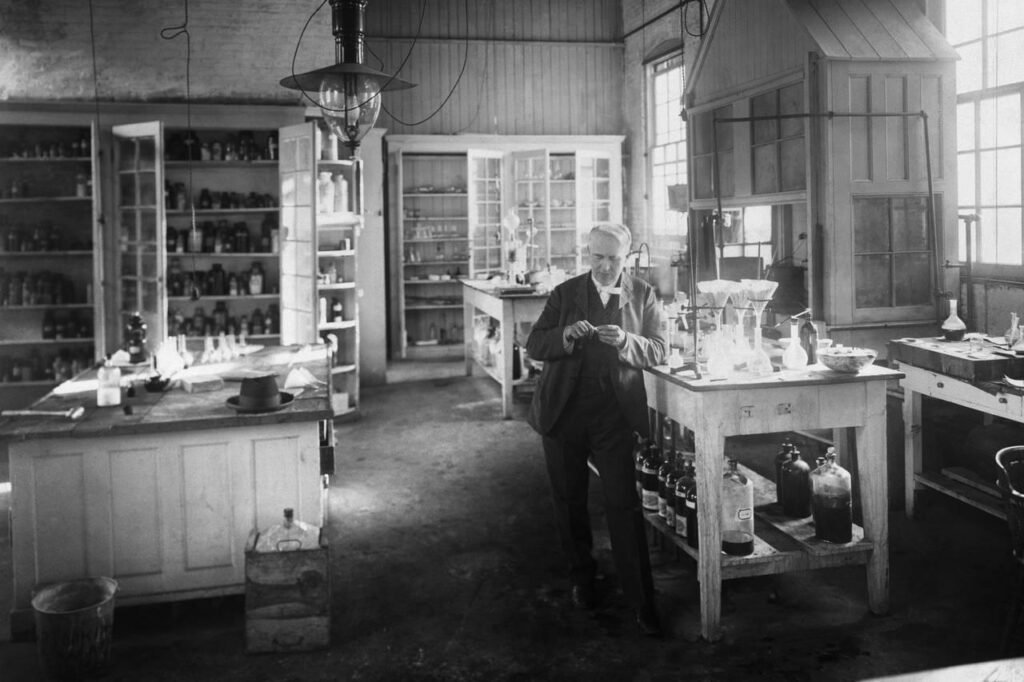
Thomas Alva Edison trabajando en el entorno experimental que convirtió a Menlo Park en uno de los primeros grandes centros de innovación tecnológica industrial.
Thomas Alva Edison was 21 years old in 1868. Ambitious but poorly educated, he wanted to emigrate to “fabulous South America” in search of a future. He began the journey and, with two traveling companions, reached New Orleans. There he was persuaded not to continue south and turned back. His friends continued and, shortly afterward, became victims of yellow fever in Central America.
Back in Boston, Edison became fascinated by a book by Michael Faraday on physical phenomena and became an inventor. His first success was an improvement to the electric telegraph, the first of 1,097 patents that would bring him fame and millions during his lifetime.
“By a hair,” one biographer says, “we almost lost the American dream, the most useful citizen, a benefactor of humanity and the prototype of the great inventor.” More than that, he inspired generations of young Americans through the story of his life, A Boy’s Life of Thomas Alva Edison, which became a school reading text.
Edison was an inventor, not a scientist. However, while experimenting with his electric lamp at Menlo Park —the world’s first technology factory in which scientists actually worked— he detected a curious bluish-light phenomenon caused by electrons passing from one filament to another.
The “Edison effect,” through developments by other researchers —Thomson, Fleming, De Forest, Hertz and others— and scientific theories that explained it —Maxwell, Planck, Einstein and others— gave rise to a revolution whose culmination was the invention of semiconductors by Shockley’s group in 1947.
Thus, the Wizard who escaped disaster by abandoning his journey to our region —an intriguing observation: consider how little or perhaps nothing he might have invented here, so decisive is the environment— is present at the beginning of the electronic revolution of our time, some of whose effects on our society are the subject of this article.
Over the last half century, the world has witnessed an enormous transformation originating in science and scientific technology. To evoke it, one need only think of the transistor, the pill, air transportation, biotechnology, chemicals, the laser, the computer and new materials.
The third industrial revolution through which we are passing has electronics at its center, just as the first (1750-1850) centered on the steam engine and the second (1850-1940) on electricity. The computer is its fundamental element.
Just as it is said that steam power during the first revolution replaced the routine work of human muscle, the characteristic inventions of the present revolution are control mechanisms that perform the routine work of the human brain.
Concerns about the effects of the computer invasion are varied, but perhaps the main one is “technological unemployment,” that is, the loss of jobs as machines replace human workers.
There are, however, arguments that help soften this concern. One is that, despite the Romantic legend surrounding the exploitation of workers, women and children during the first Industrial Revolution, exploitation already existed and what the revolution did was expose it.
Several scholars also argue that factories gave rise to economic reforms —Owen— and political reforms —Peel—.
Moreover, “it was horsepower, it was the engine, that produced concern for the horse, and it was the Industrial Revolution that created our sensitivity.”
But our subject is a more limited aspect of the electronic revolution: new information and communication technologies in urban life and particularly in Argentine society; video, cable television and portable telephones, three technologies that have recently attracted the attention of researchers. One example is New Technologies in the City, by Finquelievich et al., which provides some of the data used here.
Foreigners have always been surprised by the speed with which Argentines adopt innovations produced abroad. It happened with the automobile, the bathroom —and the daily shower—, radio, the electric refrigerator, the washing machine and other products.
All of these products originating in the second Industrial Revolution quickly became necessities for the average Argentine, although restrictive import policies often interfered with their availability.
What is happening now, in the midst of the third revolution, changes the scale considerably. With the economy opening and a generous exchange-rate parity, people can more easily satisfy their appetite for technological novelty.
Video has reinforced the already overwhelming influence of television. Television has established itself everywhere as an omnipresent medium for spreading lifestyles and patterns of consumption. From it, viewers receive “their daily portions of comedy, drama and tragedy.”
It is worth noting that insufficient attention has been paid to negative aspects such as its influence on children: a 1986 study argues that television delays the development of reading skills, lowers scores on creativity tests, intensifies perceptions of differences between the sexes and gives rise to aggressive verbal and physical behavior in both boys and girls.
Video rental stores grew into a “boom” after the first one opened in 1978.
By 1992 there were 6,000 in the country. The cost of VCRs had not prevented this expansion. The resulting changes in family habits and social interaction were significant.
Cable television became another “boom.” By 1992 there were already more than 600 stations in the country. Household penetration ranged between 20% and 30%.
Curiously, the lowest proportion was found in the Capital and Greater Buenos Aires. This indicates a greater need among people in the Interior of the country for alternative sources of information and entertainment, or even access to cultural goods different from those offered by their immediate surroundings.
Some sociologists call attention to two motivational traits: first, the influence of “showing others” —the “Jones effect,” those who “have” compared with those who “do not have”—; and second, the greater attraction of local programming —news programs, gatherings, sporting or artistic events and local stories.
But beyond these particularities lies the Argentine singularity. Apart from the United States, Argentina is the country that has shown the greatest growth in cable television; in Latin America, Mexico follows, but at a considerable distance.
The third phenomenon is mobile cellular telephony. The speed with which this system spread meant that Argentina reached in barely one year the level of penetration that Germany had achieved in two years and Japan in seven.
By mid-1992, there were between 30,000 and 40,000 users of these devices. They undoubtedly came to satisfy real needs. Nevertheless, when ordinary mortals see a man talking on the telephone while walking along Florida Street, we cannot help looking at him with some irony. These wandering executives have, as people say, all the appearance of the porteño who likes to show off.
The technologies mentioned above are for private use. Public-use technologies have not yet affected us as they have cities in the First World. When it comes to urban public services, our world and that of the leading countries are very different.
It is striking how little thought is given to the fact that we participate in the current Industrial Revolution only as consumers. Eager for novelty, Argentines appear in this fascinating adventure as completely dependent on the ingenuity of others.
We need ruling classes that understand that this is not an acceptable situation.
As a professor at the University of Sussex once said: “The ability to contribute to the world’s accumulation of knowledge is a sign of national self-esteem. It is partly a matter of prestige and the search for a national identity, but it goes much deeper than that.”
This is a profession of “nationalism as an idea”: nationalism understood as the capacity to assimilate what comes from abroad, requiring openness and confrontation, something different from “nationalism as ideology,” which is exclusionary and isolating.
The fabulous South America that tempted the young Edison in 1868 must someday cease to be only a fable.