Automata and chess players
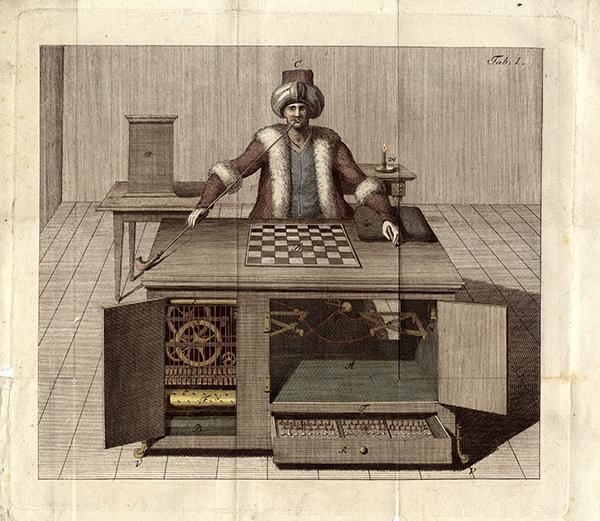
El Turco, el célebre autómata ajedrecista de Wolfgang von Kempelen, combinó mecánica, ilusión y espectáculo en el siglo XVIII.
We have once again heard a local subject being discussed, one that has always been a cause for surprise: the international relevance of our chess players. What explains the fact that a country with a small population long maintained a solid group of leading figures in such an intellectually demanding activity? Some argue that it was a gift of the Second World War, because when it broke out several important European chess players — Najdorf, for example — who had come here circumstantially for a tournament were forced to remain, and they trained disciples. Others reply that Argentina’s chess singularity came from much earlier. Decades before, we had had Benito Villegas, Roberto Grau, Maderna, Guimard, Pleci, Piazzini, etc., who shone in times when the world champions were Capablanca, Lasker, Alekhine and Keres.
Martínez Estrada said that this singularity revealed that we were a people of great intelligence. In the art of chess, the best of Argentines is manifested; what ruins us is the mercantile value given here to intelligence. He wrote: “Heretics of the general sectarian inclination, chess players represent among ourselves what we are and are ashamed to be.” In La cabeza de Goliat, he said that the most astonishing contradiction of our culture was that we had ten chess players who could measure themselves against the best in the world, while we had no philosophers, artists or scientists who could be considered on a par with the best abroad. The explanation he gave for this anomaly was that our chess players — whom he beautifully described as “artists of a transcendent and futile knowledge” — are self-taught, intelligent men who have not been spoiled by official education. But our subject in this note is not the science game itself. What we want to tell is a story related to chess, but more directly to devices made by human beings.
The idea of making artificial beings with mechanical elements is an old one in the world. The Greeks invented automata, marvelous instruments, games of illusion, such as machine birds. Archytas, for example, invented a flying dove with a voice, rolling theaters, water clocks, for which they used a sum of mechanisms, the whole kinematic chain: pulleys, gears, counterweights, multiplications, valves, programming. These were the possible ways then of giving course to mechanical ingenuity, which was concentrated in the school of Alexandria, that of Archimedes and Heron. The latter, who wrote a Treatise on Automata, is a notable figure. It has been said that “what Euclid was for geometry, Heron was for applied sciences.” Derek de Solla Price argues in Science Since Babylon that much of our technology derived from automata. Ctesibius, Archimedes and Heron achieved a sophisticated technology expressed in mechanical artifacts. In Rome, at Julius Caesar’s funeral, Antony enraged the public — that was his design — against Caesar’s killers with a figure of the dead man rising from the coffin covered in wounds. Much later, automata proliferated in Europe. In 1645, Pascal invented “the Pascaline,” a mechanical calculating machine that was the first digital computer. Descartes built “Francine,” a beautiful woman activated by magnets. When King Frederick III entered Nuremberg with his army — the region that would become the center of cuckoo clocks — an artisan subject of his awaited him with a metal eagle that flew out to greet him, flapping its wings and cawing, to the astonishment of the sovereign, the terror of his entourage and the panic of the horses.
In the eighteenth century, cases multiplied. Among the most famous builders of automata was the Swiss watchmaker Droz, the first to make music boxes and the last to attempt to solve the classic problem of “perpetual motion.” Another was the Frenchman Vaucanson, who is remembered through an amusing anecdote. After he managed to make a man who played the flute and a duck that ate, went “quack-quack” and then defecated on the stage of the theater, to the audience’s roaring laughter, Cardinal Minister Fleury, thinking that he could well apply his talent to more useful things, sent him to Orleans to improve the silk looms. The workers there, fearing that he would invent a device that would leave them without work, kicked him out. In revenge, Vaucanson then built a donkey that could operate a loom perfectly. Someone has commented that this famous loom operated by a donkey is still exhibited in the Louvre Museum in Paris. We cannot confirm that. We can still cite a famous mention of an automaton in our literature. J. L. Borges popularized the Golem, the ghostly servant of Rabbi Löw of Prague; whoever knew the letters of the true name of God could have it serve him.
But let us turn to chess, which has been a constant reference for the makers of automata, as it is today for cyberneticists who enjoy challenging champions with their devices in the recent games of Kasparov and the computer.
In Vienna in the mid-1700s there lived an official of Maria Theresa’s court named Wolfgang von Kempelen. This ingenious Austrian set out to delight the empress and built for her an automaton that played chess. It had the figure of a man dressed in the Turkish manner, sitting on a kind of throne before a table with a chessboard. The Turk played against the most skilled chess players and defeated them all. It moved each piece with its left hand and signaled by moving its head twice when it gave check to the queen and three times when it gave check to the king. It is true that at times it showed little neatness and violated the rules. For example, when it found it convenient, its king moved like a bishop or like a rook. In addition, it had a rather irascible character; after an erroneous move, it was capable of sending the pieces flying with the cane it held in its right hand.
But, in recognition of its genius, those outbursts were forgiven. Von Kempelen, the owner, walked calmly around the table, like an ambassador. If someone asked, he would show the inside of the artifact’s head, filled with wheels, levers and springs. The inventor became famous overnight throughout Europe. Two camps formed: those who believed he was a mystifier and those who thought he was a genius. But everyone wanted to see his chess-playing Turk up close, and many wanted to beat it in a game. Grand Duke Paul of Russia went to Vienna to play against it and had to lay down his major piece. The inventor received a princely prize. When he considered the time appropriate, he embarked on a tour of other countries. While he was in England, the king of Prussia, Frederick the Great, an excellent player and chess fanatic, invited him to his court. Von Kempelen arrived in Potsdam, and the chess-playing Turk defeated the monarch in three successive games. Frederick, extremely excited, paid the inventor an enormous sum for him to reveal the secret of how the prodigy worked. Once he obtained it, he told no one.
The story does not end there. Years later, after arriving in Germany, Napoleon demanded to play a game with the machine-man. The Turk turned out to be the better strategist of the two and defeated the conqueror of the world. What was the secret of the chess-playing Turk? It was never known with certainty. The general public regarded it as the eighth wonder of the world; everyone spoke endlessly of its skill, its intuition, its bold moves. Skeptics, for their part, mostly believed that it was the work of a highly ingenious mechanic who directed the movement of the iron pieces with a hidden magnetic device. A French chess player maintained that a certain Mouret — a theorist of the science game, who was short in stature — was the one who, packed inside the artifact, made the pieces move. Others imagined still subtler deceptions, involving mysterious powers. But in reality, the only person who surely knew the secret — apart from its owner — was, as we have seen, Frederick the Great, and he took it to his grave, keeping his word not to reveal it.