The progress of technique
El documento analiza cómo la técnica habría pasado del reemplazo del esfuerzo muscular a la automatización electrónica, liberando al ser humano de tareas repetitivas y ampliando su capacidad creadora.
With the progress of mechanical technique and of the sciences, particularly mathematics, man gradually eliminated that type of forced association between man as instrument and man as machine, and began freeing himself from his primitive servitude to the instrument, which characterized the long early stages of his biological and technical evolution. In those first stages, technique replaced man’s muscular labor with mechanical labor. This replacement was very slow; one need only think of how long it took to arrive at the wheel for vehicles, first used in Mesopotamia only 5,000 years ago; in Egypt, 1,500 years later, despite the fact that the potter’s wheel had been used there much earlier; and in China and Sweden, another 600 years after that.
Thanks to electronic technique, man can leave his mind free for creative work and for the plain and simple enjoyment of life, which is one of the most important human tasks. The electronic machine entirely replaces man’s production labor; he sets the task and the machine carries it out. In the execution process, the electronic machine provides the necessary data to determine whether its functioning, and even its structure, is correct or incorrect. In factories with automatic controls, man does not need to watch the operation of machines tensely or anxiously in order to correct their defects. The machines themselves detect them, and, if properly equipped, correct them. The correction may exceed the limits of their capacity, as happens with any biological organism. It may be said, without the slightest risk of error, that electronic machines have shown themselves capable of making “decisions” regarding the task they perform. Man is endowing them with that power.
Machines become fatigued; they suffer from lack or excess of nourishment, from lack or excess of activity; they undergo crises similar to nervous crises, which will increase as more complex electronic machines are manufactured. The ultrasensitive electronic machines of the future will need, like the ultrasensitive men of the cities that manufacture them, “clinics” to cure them of their “nervous crises.” Automatism in mechanical technique is a crucial stage of evolutionary technique. The control system is the most important part of all forms of automatism, and includes: a “sensory unit,” which reports what is happening in the mechanism in operation, in terms of speed, pressure, density, size, weight or any other measurable factor; a “memory unit,” or main register, which knows what should be happening; a “comparison unit,” which compares the information gathered by the sensory unit with what the memory unit has recorded and indicates what should be done; and an execution unit, which changes the process or operation according to the instructions of the comparison unit.
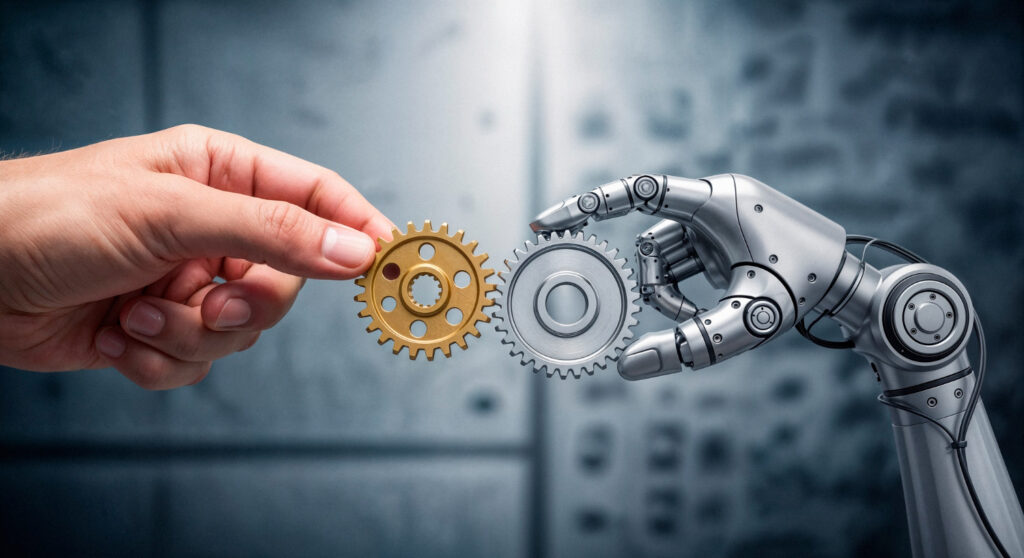
The speed and precision with which a control machine detects changes or alterations in the creation process entrusted to it could not be replaced by a chain of men running from the control point to the point where the alteration or change occurs, and then returning again to the control point. Electronic technique saves man from becoming the main victim of the growing complexity of his technical creations. In the first decades of this century, the forced growth of the production process led to the mechanization of countless tasks, which forced most workers throughout the world to work as gears in the machine they tended. Man’s exhausting servitude to the machine was sometimes viewed with horror, sometimes with irony, and as a descent of man. But it was, perhaps, a necessary tribute, because it hastened the maturity of automation, which is repairing that serious flaw. Automation is freeing man from the tiring repetition of the same task or movement: it is, one might say, “human.” The automatic control system is not an exclusive creation of our time, although the way in which it is spreading is. The windmill, the steam engine and the voltage regulator are old examples. The thermostat is a control system similar to that of the human organism. Our organism, like everything that lives, is subject to automatic controls; when these controls fail, life is endangered. Each of our viscera, each of our tissues, is maintained and functions on the basis of that control system. There is a close correlation between the biological control system, through which the changes that occur in the internal and external environment are compensated within certain limits, and the mechanical automatic control system.
The progress of technique is so great that the question has more than once been raised as to whether it is not leading man toward biological exhaustion or distortion. It is thought that automatic machines have mechanized man’s muscle and that the electronic computer has mechanized his brain. It should be thought instead that, by no longer demanding mechanical responses from muscle and brain — responses that automatic machines and the electronic computer can now provide — they leave them free for activities in which conception and creation play the main role.