Population. The gloomy clergyman and the cheerful marquis
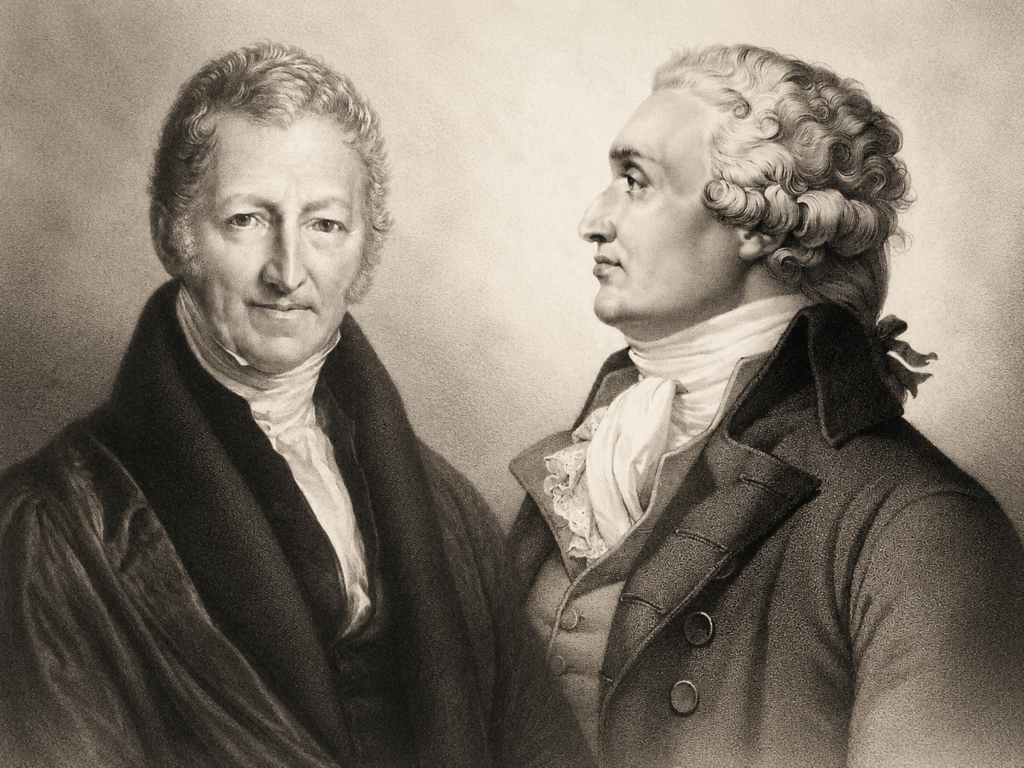
Malthus advirtió sobre los límites que el crecimiento demográfico impondría a los recursos, mientras Condorcet confió en la educación, el desarrollo y la autonomía de las mujeres como herramientas para alcanzar un equilibrio poblacional.
The ecumenical meeting in Cairo on world population reached a surprising consensus. It committed governments to adopting a positive policy and allocating 17 billion dollars a year to reducing population growth. The strategy was to give women power and participation in public life so that, through this, they would be able to decide autonomously how many children to have.
Two hundred years after his death, the world seems to be proving an optimist entirely right: the Marquis de Condorcet.
Thomas Malthus gave classical form to the alarmist and restrictive view of world population. He argued that population would always grow to the limit of available subsistence. Population increases geometrically, while food production increases only arithmetically. It was the view of a pessimist, one of those who did the most to earn economics the description of the “dismal science.”
Poverty was inevitable. For that reason, he called for the abolition of the Poor Laws: they interfered with labor mobility and encouraged biological fertility. And because his theory colored the thinking of the Anglo-Saxon classical economists, it has always represented a restraint on optimism. It helped, for example, to justify an ideology that sought to limit wages and discouraged traditional forms of charity.
Contrary to his thesis, however, although the world population has multiplied sixfold since that time, the availability of food is now considerably greater. But the fact that the prediction proved wrong does not mean that there is no cause for concern.
As expressed by authors of such strikingly titled books as The Population Bomb (1969) and The Population Explosion (1990), both by Paul Ehrlich, and Garrett Hardin’s Living within Limits (1993), population growth accelerated during the present century. It took millions of years to reach the first billion people, 123 years to reach the second, 33 for the third, 14 for the fourth and 13 for the fifth. It will take 11 years to reach 6 billion. And consider that between 1980 and 1990 the number increased by 993 million, equal to the entire population of the world in Malthus’s time.
It is this kind of quantitative evidence that encourages the gloomy forecasts and apocalyptic warnings frequently voiced by the “doomsters,” the most uncompromising pessimists.
But it is now known that societies successful in achieving economic development tend to moderate their population growth. Consequently, a more moderate approach has emerged: economic and social development would be the remedy for the problem. This has been the experience of the countries of Europe and North America. Industrialization, wealth, education and greater availability of contraceptive methods dramatically reduced birth rates in various developed countries.
An even more telling fact is provided by the World Bank’s World Development Report 1994, which shows that over the previous two decades the annual rate of world population growth fell from 2.2 percent between 1970 and 1980 to 1.7 percent between 1980 and 1992. The latest statistics published by the United Nations give a medium projection of 9.4 billion people by 2050 and a low projection of 7.7 billion by 2040, an estimate considered “reasonable and plausible” by experts. It could therefore even be assumed that the population will become almost stationary in the future.
There is a broader way of looking at the issue, known as the “collaborative approach.” According to this view, confidence should be placed in the rational decisions of women and men, based on expanded choices and public discussion, all of it supported by policies that provide educational opportunities, health care and access to family planning.
A distant and illustrious precursor of such a policy was the Marquis de Condorcet. He is a leading figure on this subject. Condorcet is known as an important thinker within the movement of absolute faith in reason that we call the Enlightenment, but few would identify him as the creator of original thinking on the subject discussed here. This can be seen in the way he approached the problem of world population.
But first, he should be placed in context. Wealthy and distinguished, he was a friend of the most powerful and a biographer of some of the most famous figures of his time, including Voltaire and Turgot. He married the most beautiful young woman in France and rose politically until he became a leader of the moderate wing —the Girondins— of the revolutionaries of 1789. His moderation cost him, of course, in his confrontation with Robespierre and the Jacobins.
And then there is the most curious fact in his remarkable biography: while in prison awaiting the guillotine —which poison prevented from reaching him first— he wrote the most optimistic book about humanity’s future: Sketch for a Historical Picture of the Progress of the Human Mind. There, based on the continuation of long-term historical trends, he predicted a future age in which, once inequality between nations and social classes had been destroyed, an era would emerge in which the intellectual, moral and physical nature of human beings would be infinitely perfectible.
The ideas about population contained in the Sketch never achieved an influence comparable to those of Malthus, perhaps because they fit poorly with material interests and with the bitter disposition of the economists of his time. They were, however, undoubtedly more original and prophetic.
Condorcet argued that the problem of population growth could be solved through rational action by nations aimed at increasing productivity, better conserving resources and providing education to the population, particularly to women. Family planning could be encouraged through a better understanding of this basic truth: if people have a duty toward those who have not yet been born, that duty is not to give them existence but to give them happiness.
Unlike Malthus, the marquis was not concerned that population growth might lead to food shortages; he was concerned about the possibility of a continuing decline in human happiness caused by deteriorating general living conditions. More than the problem of food, he was concerned about the damaging impact of a larger population on the environment.
More specifically, he proposed, first, developing better technical use and management of resources, together with new technologies and patterns of social behavior that would waste and pollute less; and second, encouraging social and economic changes that would gradually reduce the rate of population growth, not only by improving economic opportunities and security but also through education, particularly for women.
Reason, productivity, technology, environmental preservation, economic and social change, education, and human happiness as the highest value. The presence of these themes in revolutionary international agreements of our own time —first the Rio de Janeiro Conference on Environment and Development and later the World Population Conference in Cairo— invites reflection on the prophetic capacity of that illustrious man condemned to death.